Skip to content

Why Businesses Are Switching to Cloud PBX?

Why Businesses Are Switching to Cloud PBX?
The Future of Communications in the Arab World

Did you know that more than 60% of communication system breakdowns in Arab companies are caused by traditional PBX systems?
In the age of Artificial Intelligence (AI) and operational flexibility, relying on on-premises IP PBX has become a technical and financial burden…

The difference between Cloud PBX and traditional IP PBX

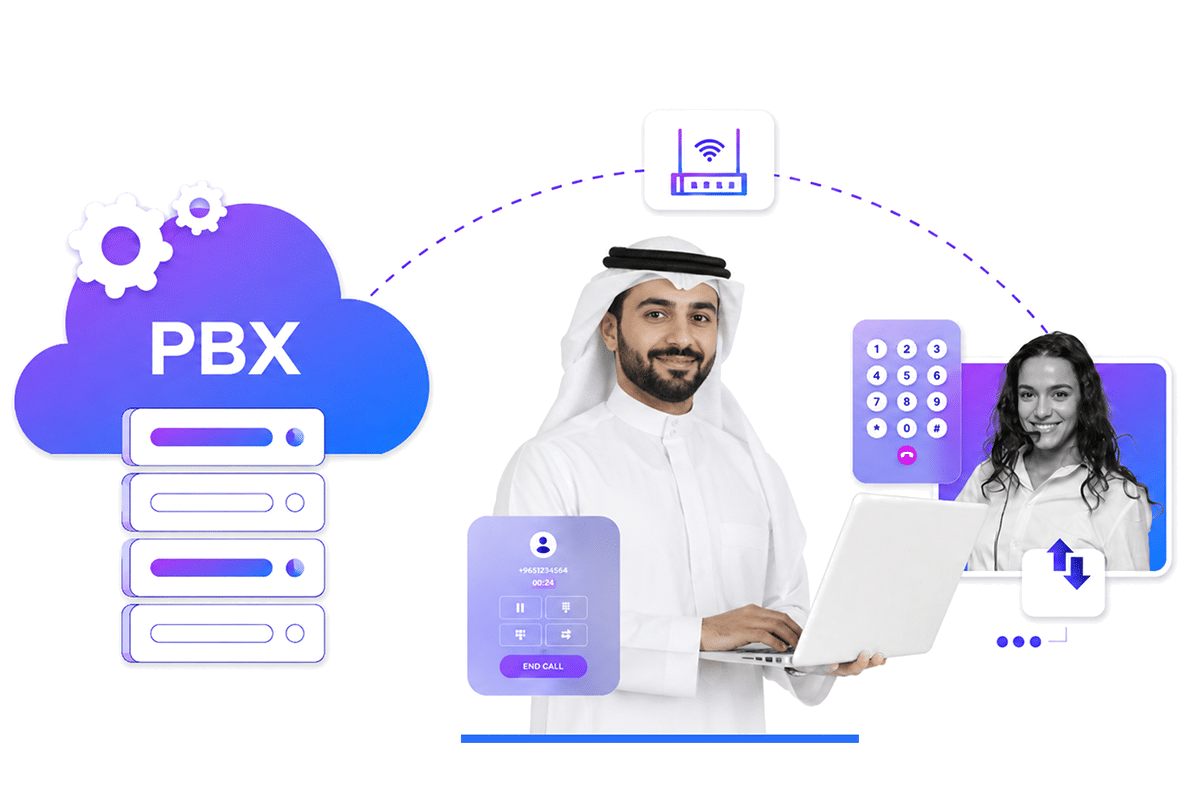
To begin with, it is important to define an internal communications system. An on-premises PBX (Private Branch Exchange) is a telephone system used by organizations and companies to manage internal and external calls. These systems typically rely on on-site desk phones, servers, and firewalls, unlike today’s modern cloud-based solutions.  Known by various names such as Cloud PBX, Hosted PBX, or Virtual PBX, it is a Voice over Internet Protocol (VoIP) solution that can be accessed through a cloud-based IP network. This technology relies entirely on the internet and is hosted outside the company in global data centers, unlike traditional PBX systems.

The Cloud Communications Transformation Strategy
  1. Current state analysis: Before making the transition, you must answer the following questions to assess and define your needs and requirements for the cloud-based system, such as:
  • Number of current users.
  • Number of external lines.
  • Number of branches.
  • Existing system features, such as call recording, interactive voice response (IVR), conferencing, detailed reports, etc.
  • Types of existing phones and protocols they support (Analog phones or IP phones) Do they support modern protocols?
  • Current internet quality at the headquarters and branch offices.

2. Selecting a service provider: The cloud service provider should be chosen based on the features they offer and the company’s specific requirements, such as:

  • Does it support the previous requirements?
  • Does it provide support for mobile applications?
  • Does it comply with global security and protection standards?
  • Does it adhere to industry-standard service quality standards?
  • Does it support any additional requirements you may have, such as CRM or integration with other systems?
3. Choosing the right switching method for your company:

  • Full transition: Some companies are transitioning entirely to the cloud-based PBX system and completely discontinuing the on-premises PBX system.
  • Partial or hybrid transition: Some companies prefer a hybrid communications system, in which some departments or branches operate on the cloud-based system and others continue to operate on the on-premises PBX system, with the two systems connected.
  • Branch-Based transition: Some companies prefer to transfer specific branches to the cloud while keeping remote branches or those without limited internet infrastructure on the on-premises PBX system.

4. Ensure availability of necessary infrastructure: This mainly depends on the internet, its quality and speed, and the availability of backup internet lines to guarantee service continuity.

5. External number porting: This involves transferring external numbers linked to the on-premises PBX at your company or current service provider to your new cloud PBX, along with the necessary settings (IVR & Queue or Ring Group).

6. Training employees on the new cloud-based communication system: Especially if there is a significant difference between your company’s current system and the new cloud-based system, users will need training to familiarize themselves with the system and to help them access features similar to those in the old system.

7. Monitoring and support: Once you start operating on the new cloud system, monitoring and supervising will be required, to oversee employee performance, monitor system stability, and intervene if necessary.

The technical and economic benefits of switching to a cloud-based communications system:
First: The financial benefits of a Cloud PBX System
  1. Reduced capital costs: There are no need for servers, server rooms, server cooling systems, or backup power systems such as UPS.
  2. Clear and fixed monthly or annual subscriptions: there are no surprises or unexpected expenses such as server failures or firewall devices, etc.
  3. Reduced operational costs: There are no expenses for technicians and engineers to operate the system, as all malfunctions and maintenance are handled by the service provider.
  4. Reduce indirect or hidden costs: such as electricity bills, cooling expenses, and the space required for server rooms.
  5. Higher productivity and greater Return on Investment (ROI): Thanks to faster system performance and scalability, increased employee productivity and minimized downtime.

For example, let’s assume a company with 50 employees:

  • In the case of an on-premises system: The cost may reach $25,000 (including servers, cables, and telephones), all of which must be paid in advance before the system goes live, with average annual operating costs reaching $8,000 per year.
  • In the case of a cloud-based system: the cost can be less than $10,000, depending on your choice of devices and phones, with annual operating expenses of up to $5,000 per year. In any case, it is significantly less expensive than an on-premises system.
Second: The technical benefits of the Cloud PBX system:
  1. Ease of management and operation.
  2. Full management via the web browser, whether from your computer, smartphone or tablet.
  3. No periodic updates needed.
  4. No firewall issues or concerns, as the service provider handles them for you.
  5. Full scalability and flexibility, adding or reducing the number of users is easier than ever.
  6. Multi-access or from anywhere.
  7. Data encryption, Service providers typically ensure data is encrypted using the latest encryption and security technology.
Risks of switching to Cloud PBX and how to avoid them
First, financial risks:

There are no actual financial risks associated with cloud systems, but here are some points to consider when making a decision.

  1. Costs accumulation over the years: Some cost managers may have a narrow perspective when calculating the annual cost for a period such as 10 years, finding that the total cost has exceeded the initial cost of on-premise servers.
  2. Concerns about future price increases by service providers: Reputable and accredited service providers typically do not raise their prices.
  3. Duplicated costs: If the company chooses a hybrid system combining an on-premises system with a cloud-based system, the communications budget will be significantly doubled.
  4. Unexpected service interruption: Rarely occurs, for example, due to power outages, internet failures at the service provider, or natural disasters such as hurricanes and floods. However, reputable service providers take all such risks into consideration and work to avoid them as much as possible.
Second, technical risks:
  1. Full dependence on the internet: An internet outage means that communications come to a complete halt.
  2. Poor internet quality: leads to poor call quality and customer dissatisfaction and complaints.
  3. Security and privacy: Certain government institutions do not allow servers to be hosted outside their premises in order to ensure the security of customer data.
  4. Full control is in the hands of the service provider, not you: To minimize these risks, seek a provider that supports a clear SLA and full administrative privileges.

Telsip — an all-in-one cloud communications platform that combines a cloud PBX, a cloud contact center, unified OMNI channels, and a WebRTC-powered softphone, with seamless CRM integration and professional support; it delivers intelligent call management, unified conversations, and real-time reports that enhance your team’s efficiency and your customers’ experience.

For more information about Telsip products and services, leave your data and one of our specialists will contact you..

    Back To Top